
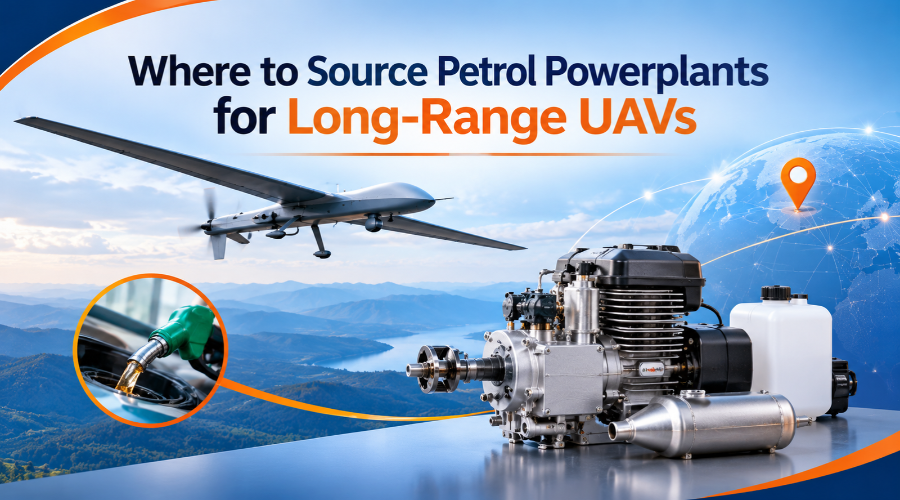
Finding a petrol engine for a UAV is only the first step. As a buyer, you also need to know whether it fits your airframe, what comes with it, and who will support you after delivery.
That’s where sourcing becomes complex. Two engine suppliers might quote engines of similar size, but that is not the full story. The complete order would include different accessories, documentation, and after-sales service. Unless you look beyond the headline price, you will not be comparing equivalent offers.
So, start with your aircraft’s requirements, then use them to guide your supplier search. Here’s how to approach the decision.
Finding a gas engine for target drones
If you are looking for a gas engine for target drones, engine manufacturers are often the first place to start looking. They provide model-specific information and clarify which configurations are available. Directly contacting the engine supplier is particularly useful when your engineers have questions about installation or operating limits.
Authorized distributors are another route of procuring engines. These include several manufacturers or provide regional sales and support. Before proceeding, check their relationship with the manufacturer and establish who handles technical questions and warranty claims.
Another valuable source to identify engine suppliers is industry events and professional networks. Treat those introductions as the beginning of your assessment.
Where RC aircraft engine sourcing fits
RC aircraft engine sourcing helps you discover commercially available petrol engines and broaden your initial search. But an engine used in an RC aircraft is not completely compatible with your UAV.
To ensure compatibility, you need to ask for the current datasheet, installation instructions, and maintenance information. Your engineering team can then assess whether the proposed configuration meets the airframe’s needs. Otherwise your procurement professional would be wasting time negotiating an unsuitable offer.
The role of an aircraft engine trader
An aircraft engine trader or sourcing partner helps you identify suppliers. They can collect quotations on your behalf and coordinate commercial questions. That kind of support proves to be valuable when you’re approaching several manufacturers or buying across borders.
Agree on the partner’s role early in the sourcing process. Are they introducing you to a supplier, purchasing on your behalf, or selling the engine directly? The answer determines who provides the quotation and who is responsible if a problem arises.
A sourcing partner makes the procurement process easier. But your team still has the final say in locking in the deal. Your engineering team remains responsible for assessing the engine and approving the purchase.
What to clarify with Hong Kong sourcing
Hong Kong sourcing is another suitable option when you’re working with a regional trader or arranging an international purchase. Here also you need to be aware of the details of the offer.
Confirm whether the engine is in stock or sourced to order. Ask who will provide warranty support and who will manage freight and export paperwork. You should also establish the manufacturer and country of origin before comparing the offer with alternatives.
Comparing the engine size range
|
Listed size |
What to investigate |
|
66 cc |
Weight, dimensions, and available configuration. |
|
110 cc |
Rated output, mounting requirements, and included components. |
|
120 cc |
Model specifications and differences from nearby options. |
|
170 cc |
Cooling, accessories, and maintenance requirements. |
|
230 cc |
Complete configuration weight and supplier support. |
|
351 cc |
Whether the figure is an exact displacement or model designation. |
|
360 cc |
Configuration options, documentation, and lead time. |
|
400 cc |
Installation requirements, accessories, and parts availability. |
But don’t compare displacement in isolation. Engines of similar size can differ in weight, dimensions, and output. Ask what each quoted figure includes and, for performance figures, the conditions under which it was measured.
Start with long-range UAV propulsion requirements.
For long-range UAV propulsion, the best way to select is to know the specs of your aircraft and then match the catalog. The correct method is for the engineering team to first define the installation space, weight constraints, operating environment, and required interfaces based on the UAV model.
Then review each option against those requirements. Important features to consider during selection are specs like engine and accessory weight, mounting arrangement, and cooling needs. After finalizing these, also check the compatibility with the aircraft’s fuel, electrical, and control systems. Maintenance access matters too: your team needs to be able to service the installed configuration.
If a supplier’s datasheet has missing information, ask for clarification before treating the engine as a viable option. A short technical discussion now can save a longer procurement cycle later.
Compare long-range fixed-wing drone propulsion systems as complete installations.
When evaluating long-range fixed-wing drone propulsion systems, you need to be even more careful with the checking of details. You need to know what the complete configuration requires. Just knowing the engine weight and price is not enough.
For example, one quote will include ignition and exhaust components while another lists them separately. Your engineering team should identify the required configuration.
A qualified team should validate the installation and carry out testing appropriate to the aircraft and applicable requirements.
Assessing COTS 2-stroke petrol engines for attritable UAVs
Commercial standard products will provide a starting point when sourcing COTS 2-stroke petrol engines for attritable UAVs. These engines have varying designs, so availability in a catalog does not necessarily mean the exact configuration you need is ready to ship.
Ask whether the engine is new, refurbished, or surplus. After that, confirm what components and manuals come with it. Moreover, if you plan on repeat orders, then you need to discuss how future supply will be handled.
Planning heavy-duty two-stroke UAV engine procurement
For heavy-duty two-stroke UAV engine procurement, consider the support you will need after the first order. Some vital questions to ask at this stage are spare parts availability, maintenance information, warranty exclusions, and how the supplier identifies the configuration it delivers.
This is especially important when you are sourcing through a trader. Establish which company will respond to technical or warranty questions, and get that responsibility recorded in the sales agreement.
Give each shortlisted supplier the same requirements. That makes it easier to compare the price quotes without relying on assumptions.
A useful quote should include the manufacturer, model, exact configuration, and quantity. It should also include,
If one quote is cheaper, then you need to check its scope before making a decision. The price difference may reflect an accessory, freight charge, or support service that another supplier has included.
Before ordering, ask which documents you’ll receive and when. This depends on the transaction. Common documents that are usually included are a technical datasheet, installation and maintenance instructions, and a commercial invoice. In addition to this, origin information and warranty documents are also included.
If traceability matters to your purchasing process, ask about serial number or batch information. You should also confirm import and export requirements with your logistics and compliance advisers; these vary by product and destination.
Agree on an Incoterms rule, its named place, and the applicable version. This helps clarify certain responsibilities for delivery, costs, and risk. It does not replace the sales contract, so make sure the wider agreement covers the commercial terms of your purchase.
A clear request for quotation gives suppliers a consistent basis for responding. It also helps your engineering and procurement teams compare the results. Chenyi Aviation is one such drone trading company that helps buyers in sourcing drones for deployment. We maintain an up-to-date inventory of drones from major drone brands of the world and can help you source them easily through supply-demand matching.
Include your company and contact details, intended application, relevant airframe requirements, preferred engine models or sizes, quantity, and purchasing schedule. State the accessories, documents, and support you need, along with the delivery destination and requested response date.
Need a drone fleet that takes your operations to another level? Then get in contact with our team to get a custom quote.
Finding a petrol engine for a UAV is only the first step. As...
READ FULLThe industrial drone industry is evolving rapidly, creating new opportunities across sectors such...
READ FULLAs the global drone industry continues to expand, businesses are looking beyond product innovatio...
READ FULL

Have a question or need a quote? Fill out this form and our team will get back to you quickly!
